Why Financial Crime Compliance Risk Management Needs Integrated, Data-Driven Technology and a Bi-Directional View of Customer and Enterprise Risk
Financial crime compliance is moving through an important transition. For years, many institutions treated the enterprise-wide financial crime risk assessment as a periodic regulatory deliverable: a document, often supported by spreadsheets, that summarized risks across customers, products, services, geographies, and delivery channels.
That approach is no longer enough.
Across the United States, United Kingdom, and European Union, regulatory expectations are increasingly converging around a common theme: financial institutions must demonstrate that AML/CFT programs are risk-based, operationally effective, current, documented, governed by senior management, and responsive to changing risk.
The terminology differs by jurisdiction. FinCEN speaks in terms of risk-based, reasonably designed, effective AML/CFT programs. The UK Money Laundering Regulations require policies, controls, and procedures that mitigate and manage effectively identified money laundering and terrorist financing risks. The EU's new AML Regulation requires internal policies, procedures, controls, business-wide risk assessments, customer due diligence, compliance monitoring, remediation, and management body approval. But the practical direction is similar: regulators expect firms to connect customer-level risk understanding with enterprise-level risk management.
That shift has significant implications for enterprise-wide financial crime risk assessments, customer risk rating programs, and the technology platforms that support them.
The Regulatory Expectation Is Moving from Documentation to Demonstrated Effectiveness
The core regulatory message is becoming clearer: financial institutions must be able to demonstrate that their AML/CFT programs are aligned with their actual risk profiles.
FinCEN's April 2026 proposed AML/CFT program rule is important because it would promote risk-based, reasonably designed programs and greater consistency in how banks are evaluated for effectiveness. The Federal Register notice explains that the proposal is intended to move supervision and enforcement away from mere technical compliance and toward significant or systemic failures to implement an effective AML/CFT program.
The UK regime has long reflected a similar concept. Under Regulation 19 of the Money Laundering Regulations 2017, a relevant person must establish and maintain policies, controls, and procedures to mitigate and manage effectively the risks identified in its risk assessment. That is an effectiveness standard in practical terms: controls must not merely exist; they must be designed and maintained to manage the firm's actual risks.
The EU framework is moving in the same direction. Regulation (EU) 2024/1624 requires obliged entities to maintain internal policies, procedures, and controls to mitigate and manage effectively money laundering and terrorist financing risks identified at the EU, Member State, and obliged entity levels. It also requires those controls to be proportionate to the nature, risk, complexity, and size of the entity.
The practical implication is significant. An institution cannot persuasively demonstrate AML/CFT effectiveness if its customer risk ratings, transaction monitoring, sanctions screening, alert outcomes, SAR or STR activity, control testing, and enterprise-wide risk assessment operate in disconnected silos. A modern financial crime compliance program needs an integrated risk intelligence capability.
Customer Risk and Enterprise Risk Are Converging Regulatory Themes
One of the strongest points of similarity across the U.S., UK, and EU regimes is the connection between customer risk and enterprise, business-wide, or firm-wide risk.
At the customer level, regulators expect institutions to understand who the customer is, the nature and purpose of the relationship, beneficial ownership, expected activity, geographic exposure, products and services used, and changes in behavior over time.
At the enterprise level, regulators expect institutions to aggregate that information to understand how risk manifests across business lines, products, geographies, channels, legal entities, and control environments.
This is where customer risk rating and enterprise-wide risk assessment become naturally connected. Customer risk factors are not merely onboarding data. They are enterprise risk inputs. Enterprise risk conclusions are not merely board-reporting outputs. They should be used to inform customer-level scoring and ongoing monitoring.
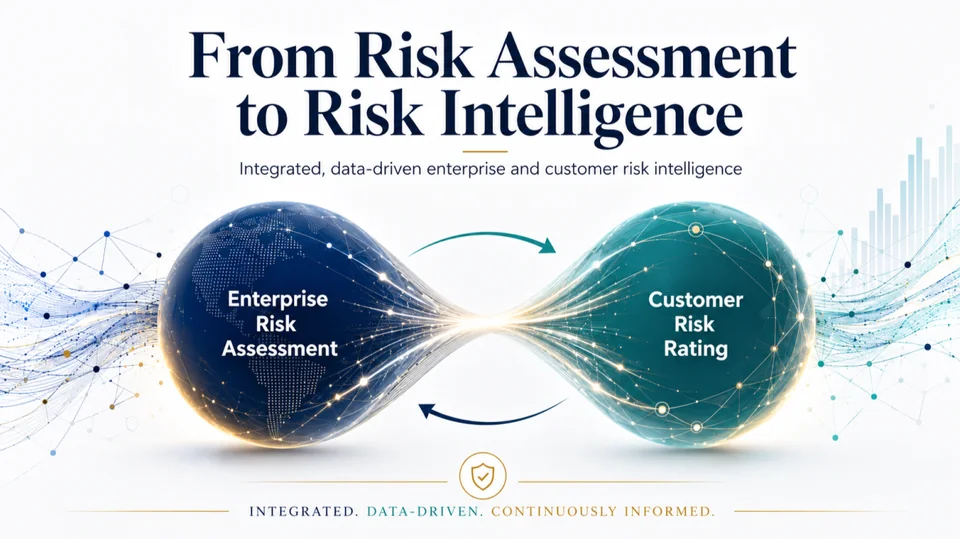
The Bi-Directional Risk Loop: Enterprise Risk Informs Customer Risk, and Customer Risk Refreshes Enterprise Risk
A more mature financial crime risk framework should not treat customer risk and enterprise risk as a one-way relationship. The relationship should be bi-directional.
Enterprise-wide risk assessment produces important risk determinations that should feed into the customer risk rating system. For example, an institution may determine that a particular product is high risk because of its design, function, transaction velocity, cross-border use, anonymity features, customer eligibility, distribution channel, third-party involvement, or typology exposure. That product risk conclusion should not remain only in the enterprise-wide assessment. It should become a structured input into the customer risk rating model.
If a customer selects or uses that product, the product's inherent risk should influence the customer's risk score. The same logic applies to geography, delivery channel, customer segment, industry, entity type, and higher-risk service features. Enterprise risk assessment identifies and rates these risk drivers; customer risk rating applies those drivers to actual customer relationships.
The flow must also move in the opposite direction. The customer risk rating system should feed the enterprise-wide risk assessment by showing how risk is actually distributed across the institution. For a product that has been rated high risk, the customer risk system can provide critical enterprise intelligence: how many customers use the product, what types of customers use it, how many are higher-risk customers, what geographies are involved, what transaction patterns are emerging, whether EDD exceptions are increasing, whether periodic reviews are overdue, and whether suspicious activity indicators are appearing.
In other words, enterprise risk assessment defines the risk characteristics of products, services, channels, geographies, and customer segments. Customer risk rating applies those characteristics at the customer level. Aggregated customer risk data then validates, challenges, and updates the enterprise risk assessment.
Illustrative Example: Product Risk as a Two-Way Data Flow
Risk intelligence flow
What happens
Why it matters
Enterprise risk to customer risk
Enterprise assessment determines that a product is high risk based on design, function, customer eligibility, transaction velocity, cross-border functionality, third-party dependencies, or typology exposure.
That product rating becomes a structured input to customer risk scoring when the customer selects or uses the product.
Customer risk to enterprise risk
Customer risk platform aggregates who is using the product, customer risk levels, geographies, volumes, behaviors, exceptions, alerts, and SAR/STR activity.
The enterprise assessment can validate whether the product risk rating is still accurate, increasing, decreasing, or concentrated in particular customer segments.
Control feedback loop
Monitoring results, QA findings, control testing, model validation, and remediation status are linked to both product-level and customer-level risk.
The institution can determine whether controls remain commensurate with the actual risk profile and whether residual risk is within appetite.
Why Traditional Enterprise-Wide Risk Assessments Fall Short
Many enterprise-wide financial crime risk assessments remain too manual, too static, and too disconnected from operational data. They often rely on annual questionnaires, business-line interviews, spreadsheet scoring, and subjective judgments that are difficult to validate or challenge.
Those inputs are not useless. Business judgment remains important. But standing alone, they are not enough to support today's expectations.
A traditional risk assessment often struggles to answer basic but critical questions: Why did this business line receive this risk rating? What data supports the conclusion? How did customer risk ratings influence the enterprise-wide assessment? Did changes in transaction activity, geography, products, delivery channels, or customer mix alter the institution's risk profile? Were control weaknesses reflected in residual risk? Did the risk assessment lead to specific resource, monitoring, staffing, testing, or governance decisions?
It also may fail to push enterprise-level risk conclusions back into customer-level decisioning. If a product, channel, or geography is rated high risk at the enterprise level, but that rating is not incorporated into the customer risk score, the institution has a break in its risk logic.
If the institution cannot answer these questions with evidence, the risk assessment may look more like a compliance artifact than a risk management tool.
Technology-Based Risk Assessments Create a Stronger Foundation
A technology-based, data-driven enterprise-wide financial crime risk assessment allows an institution to connect risk identification, control assessment, residual risk analysis, governance reporting, customer risk scoring, and remediation tracking in a more disciplined way.
An effective platform should be able to integrate data from customer risk rating systems, KYC and onboarding systems, CDD and EDD workflows, transaction monitoring systems, sanctions and adverse media screening systems, fraud systems, SAR and investigation case management systems, product and channel data, geographic exposure data, legal entity and business-line data, QA and audit findings, model validation results, regulatory examination findings, issue management, remediation tracking, training, staffing, and control performance metrics.
This integration changes the nature of the enterprise-wide risk assessment. Instead of asking business units to describe risk in broad terms, the institution can analyze actual risk drivers and control performance indicators.
For example, the assessment can show whether a business line has experienced growth in high-risk customers, increased exposure to higher-risk jurisdictions, increased use of higher-risk products, a rising volume of unusual activity alerts, deteriorating investigation timeliness, increased sanctions screening hits, or recurring control exceptions.
Just as important, the technology can push enterprise-level risk ratings back to the customer risk platform. Product, geography, channel, and segment risk determinations should become reusable data elements within customer risk scoring, onboarding decisioning, periodic reviews, and ongoing monitoring.
Customer Risk Rating Technology Is the Natural Foundation
Customer risk assessment technology and enterprise-wide risk assessment technology should not be treated as separate, unrelated processes. They are naturally connected, and the connection should operate in both directions.
The customer risk rating process captures many of the core data elements needed for an enterprise-wide financial crime risk assessment, including customer type, geography, products and services, expected activity, beneficial ownership, industry, PEP status, adverse media, sanctions exposure, source of funds, source of wealth, and transaction behavior.
At the customer level, the question is: What financial crime risk does this customer present? At the enterprise level, the question becomes: What does the aggregation of customer risk tell us about risk across business lines, products, geographies, channels, legal entities, and the institution as a whole?
The aggregation is extremely valuable. If a customer risk rating platform shows that a particular business line has a concentration of higher-risk customers, complex legal entity structures, digital asset-related activity, cross-border flows, cash-intensive businesses, or unusual transactional patterns, those insights should feed directly into the enterprise-wide risk assessment.
The reverse is equally important. If the enterprise-wide assessment identifies a product as high risk, the customer risk rating system should recognize that product rating when customers select or use the product. If the enterprise-wide assessment identifies a geography, delivery channel, or customer segment as elevated risk, those ratings should also be reflected in customer-level scoring and monitoring logic.
This creates a dynamic feedback loop: enterprise risk determinations influence customer-level risk scoring, and customer-level outcomes continuously refresh enterprise risk conclusions.
The UK, EU, and FinCEN Proposal Point in the Same Direction
Although the legal frameworks differ, the U.S., UK, and EU regimes show several important points of alignment.
First, all three regimes emphasize a risk-based approach. FinCEN's April 2026 proposal focuses on risk-based, reasonably designed programs. The UK requires risk-based policies, controls, and procedures to mitigate and manage identified risks effectively. The EU requires controls proportionate to the nature, complexity, size, and risks of the obliged entity.
Second, all three regimes require a meaningful connection between customer risk and broader institutional risk. Customer due diligence is not merely a customer onboarding exercise. It is a source of risk intelligence that should influence ongoing monitoring, risk assessment, control design, governance reporting, and remediation.
Third, all three regimes expect firms to keep risk assessments and controls current. The EU requires business-wide risk assessments to be documented, kept up to date, and reviewed when internal or external events significantly affect risk. The UK requires policies, controls, and procedures that are maintained and responsive to identified risks. FinCEN's proposal similarly emphasizes alignment with actual risk and program effectiveness rather than technical compliance.
Fourth, all three regimes place importance on governance. The EU requires the business-wide risk assessment to be drawn up by the compliance officer and approved by the management body. The UK framework embeds senior management responsibility in the design and operation of AML controls. FinCEN's proposal similarly places program effectiveness within the governance and risk management framework of the institution.
Fifth, all three regimes increasingly support the idea that AML/CFT programs should be judged by whether they work in practice. That means whether the institution can identify risk, measure risk, apply controls proportionate to risk, monitor changes in risk, identify weaknesses, remediate deficiencies, and explain its decisions.
Bi-directional risk intelligence supports each of these expectations. It shows that the institution is not simply documenting risk in separate compliance processes, but using risk information to drive customer decisions, enterprise analysis, control design, and governance action.
Integrated Technology Helps Demonstrate Program Effectiveness
Regulatory expectations around effectiveness require more than policies and procedures. They require institutions to show that risks are identified, controls are aligned to those risks, and outcomes are monitored.
An integrated technology platform helps demonstrate effectiveness in several important ways.
First, it creates traceability. The institution can show how customer risk factors, product risks, geographic exposures, transaction activity, and control performance indicators contributed to inherent risk, control effectiveness, and residual risk.
Second, it improves consistency. Similar risks can be scored and evaluated using common methodologies across business lines, legal entities, customer segments, products, channels, and geographies.
Third, it strengthens effective challenge. Senior management, the board, internal audit, model risk management, and regulators can review the logic, data, assumptions, overrides, and outcomes supporting the assessment.
Fourth, it supports resource allocation. A credible risk assessment should help determine where compliance resources, monitoring scenarios, investigative staffing, testing, training, and remediation investments should be focused.
Fifth, it creates a feedback loop. Outcomes from investigations, SAR or STR filings, QA, audit, model validation, sanctions screening, and enforcement developments can be fed back into both customer risk ratings and the enterprise-wide risk assessment.
Sixth, it enables bi-directional governance. Management can see how enterprise-level risk ratings affect customer-level risk scoring and how customer-level behavior is changing enterprise-level exposure. That is far more powerful than a static annual assessment.
Case Study Lessons: What Recent Enforcement Actions Tell Us
Recent enforcement actions provide a clear warning about the consequences of weak integration between risk assessment, customer due diligence, monitoring, governance, and program effectiveness.
The TD Bank enforcement actions are among the most significant recent examples. In October 2024, the OCC announced a cease-and-desist order, a $450 million civil money penalty, and a growth restriction against TD Bank for BSA/AML deficiencies. The OCC stated that the bank's deficiencies included internal controls and risk management practices, risk assessments, customer due diligence, customer risk ratings, suspicious activity identification and reporting, governance, staffing, independent testing, and training.
The broader lesson is that risk assessment, customer risk understanding, monitoring coverage, governance, staffing, and escalation must operate as an integrated system. When the business changes and risk grows, the compliance program must change with it.
The Federal Reserve's 2024 written agreement with Customers Bancorp and Customers Bank is another useful example. The agreement required the bank to submit a revised BSA/AML compliance program that included internal controls, customer due diligence, beneficial ownership, suspicious activity monitoring and reporting, and a comprehensive risk assessment covering products, services, customer types, geographies, and transaction volumes in determining inherent and residual risk.
This is exactly where integrated technology becomes critical. Digital asset, payments, fintech, and real-time transaction environments can change faster than traditional manual risk assessment cycles. Institutions need tools that can connect customer risk, product risk, transaction behavior, emerging typologies, and control effectiveness in a timely and explainable manner.
The Enterprise-Wide Risk Assessment Should Drive Action
A strong enterprise-wide financial crime risk assessment should not end with a rating. It should drive decisions.
Those decisions may include enhancing customer risk rating methodologies, changing onboarding or EDD requirements, adding or tuning transaction monitoring scenarios, adjusting sanctions screening controls, increasing investigative staffing, prioritizing remediation plans, expanding QA or independent testing, reassessing risk appetite, escalating issues to senior management or the board, investing in new technology or data sources, or changing business strategy where risk exceeds control capacity.
The risk assessment should also drive the customer risk rating system. If the enterprise determines that a product, channel, geography, or segment presents elevated risk, that determination should be operationalized in customer risk scoring, monitoring, periodic review frequency, EDD triggers, and escalation logic.
Likewise, customer risk intelligence should drive enterprise action. If a high-risk product is increasingly used by higher-risk customers, or if a lower-risk product begins attracting unexpected risk concentrations, the enterprise risk assessment should change. The institution should not wait for the next annual cycle to recognize that the risk profile has shifted.
That is not just better compliance. It is better management.
Moving Toward Integrated Financial Crime Risk Intelligence
The future state is not merely a better spreadsheet or a more polished annual report. The future state is integrated financial crime risk intelligence.
That means customer risk ratings, enterprise-wide risk assessments, transaction monitoring, sanctions screening, investigations, SAR or STR reporting, fraud trends, control testing, model validation, audit findings, and remediation activity should inform one another.
The customer risk rating process should provide granular risk intelligence. The enterprise-wide risk assessment should aggregate and evaluate that intelligence. Enterprise risk determinations should feed back into customer scoring and monitoring. Control testing and outcomes analysis should validate whether the risk assessment is accurate. Governance reporting should translate the results into decisions. Remediation tracking should ensure that identified weaknesses are corrected.
And the entire process should be supported by reliable data, transparent methodology, documented assumptions, explainable scoring, and effective challenge.
Conclusion
Financial crime compliance is no longer about proving that required program elements exist. It is increasingly about proving that the program works and effectively manages financial crime risks.
FinCEN's April 2026 proposal, the UK Money Laundering Regulations, and the EU's new AML Regulation all point toward the same practical expectation: customer risk, enterprise risk, controls, governance, and outcomes must be connected.
An integrated, technology-based enterprise-wide risk assessment and customer risk rating process helps institutions meet that expectation. It creates a direct line of sight from customer-level risk to enterprise-level exposure, from enterprise-level risk determinations to customer-level scoring, from inherent risk to control effectiveness, and from residual risk to management action.
The strongest frameworks will not treat customer risk and enterprise risk as separate annual exercises. They will recognize the bi-directional relationship between them. Enterprise risk assessments define product, geography, channel, and segment risk. Customer risk systems apply those risk factors to real relationships. Aggregated customer outcomes then validate, challenge, and refresh enterprise risk conclusions.
Institutions that make this shift will be better positioned to demonstrate that their AML/CFT programs are risk-based, reasonably designed, and effective. They will also be better equipped to identify emerging risks, allocate resources, support innovation, and withstand regulatory scrutiny.
In the current environment, the enterprise-wide financial crime risk assessment should not be a static annual exercise. It should be a dynamic, data-driven risk management capability.